

October 1, 2026
Back to the Basics: Investing in Real Estate
without an Accommodating Bond Market
Abstract
Financial engineering no longer drives performance. The era of relying on a highly accommodative bond market to manufacture real estate returns through leverage has unequivocally ended with loans pricing at higher interest rates and lower LTVs.
Basis must stand on its own. Without the tailwinds of financial engineering, investments made at unattractive bases can no longer be salvaged by an accommodative debt market or cap rate compression. Instead, capital should target a defensible entry basis that is underwritten on current fundamentals without reliance on future market improvement.
Durable income, not appreciation, should anchor returns. ORG advocates that a minimum of 50% of total return in real estate portfolios should be derived from income to insulate portfolios against valuation volatility.
Risk must be identified, distinguished and priced. While the previous cycle allowed investors to misprice risk, the accurate quantification and pricing of risk has re-emerged as a critical driver of preserving and compounding capital in today’s environment.
Introduction
From the trough in October 2022 to September 2026, the S&P 500 has generated an annualized return of 23.2%[1], establishing drastically greater competition for allocation dollars amongst other asset classes in a total portfolio. As the real estate industry continues to evolve, it is important for investors to continuously re-evaluate real estate allocations to ensure alignment with the role that real estate is intended to serve within an institutional portfolio. In a total portfolio, real estate is expected to justify its allocation by providing diversification, stable income and attractive total returns while dampening volatility and maintaining a lower correlation with traditional asset classes. Private real estate in particular is intended to capitalize on market inefficiencies through active management, generating risk-adjusted returns that complement a balanced portfolio and reward investors for the illiquidity and operational intensity that the asset class demands. Because the drivers of real estate performance shift meaningfully from one cycle to the next, investment decisions should pivot with the prevailing real estate market rather than rest on strategies calibrated to a prior cycle, continuously realigning basis, income and risk.
For much of the past decade, investors could rely on a highly accommodative debt market to manufacture returns through leverage, steadily compressing cap rates to lift valuations and robust rent growth to rescue aggressive underwriting, resulting in investment success even where basis and operations were mediocre. Now, industry wide support has receded with commercial real estate loans pricing at materially higher interest rates and lower loan-to-value ratios, cap rate compression being largely absent from the market and pro forma rent growth failing to materialize across many markets. Stripped of the financial engineering and market wide momentum that defined the previous cycle, today's market offers far less margin for error. In ORG’s view, the era of relying on the capital markets to salvage an otherwise unremarkable acquisition has unequivocally ended.
Compounding this shift in market fundamentals, ORG believes that broad thematic investment strategies have become less viable as each property type faces its own idiosyncratic supply, demand and capital markets dynamics. The market has effectively fractured to the asset level and the opportunities that remain compelling are increasingly specific rather than overarching. This fragmentation is reflected in the composition of transaction activity, where smaller deals have become far more prevalent with more than 85% of real estate transactions closing at $35 million or less[2]. Deploying capital successfully today therefore requires buyers to be highly discerning, sourcing and underwriting individual assets with precision in order to uncover mispriced opportunities rather than allocating broadly and relying on a rising market to generate returns.
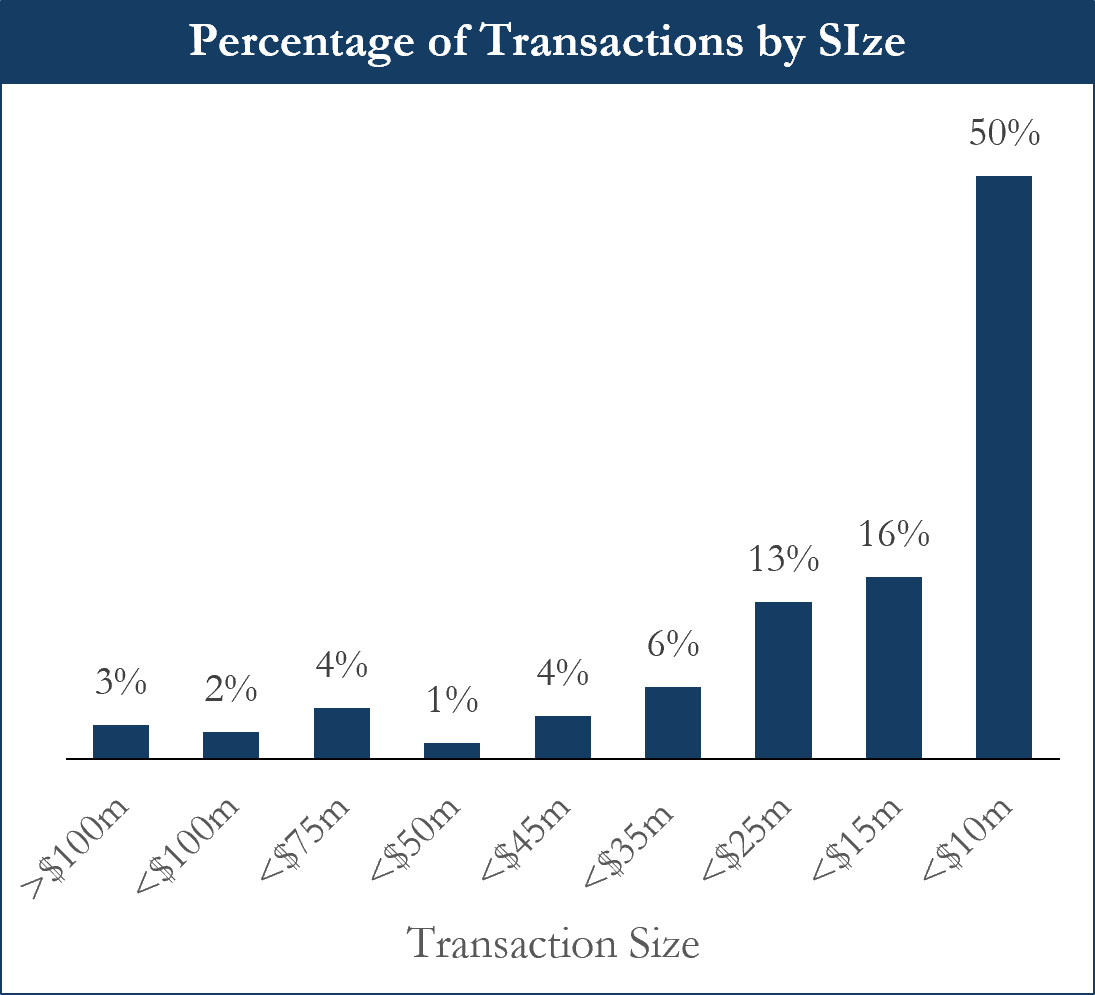
Source: CoStar; Calculated by number of transactions and not including transactions smaller than $5 million. Includes only Office, Retail, Multifamily and Industrial transactions within the last five years as of August 25, 2026.
The practical implication of this environment is a return to the “blocking and tackling” of real estate investing where disciplined fundamentals are highly influential in investment success. ORG believes that navigating the current investment landscape requires alignment with three key principles. First, investors must prioritize buying right by acquiring assets at an attractive basis that is underwritten independently of any assumed improvement in market conditions. Second, ORG encourages investors to overweight their portfolio towards durable income generation rather than speculative appreciation so that returns accrue throughout the hold period and portfolios can withstand volatility in valuations. Third, investors should accurately identify and value the risk assumed, restoring the distinction between compensated and uncompensated risk that eroded over the last cycle. Together, these disciplines outline how ORG believes capital can be preserved and compounded in a real estate market that no longer rewards leverage and directional bets.
Buying Right and the Importance of Basis
In today’s environment, institutional capital should not enter the market with the expectation that an accommodative debt market will salvage investments acquired at too high of a basis. While real estate valuations have moderated since their peak in 2022, basis has become increasingly important as transaction volume has continued at pace despite lower cap rates compared to historical averages.
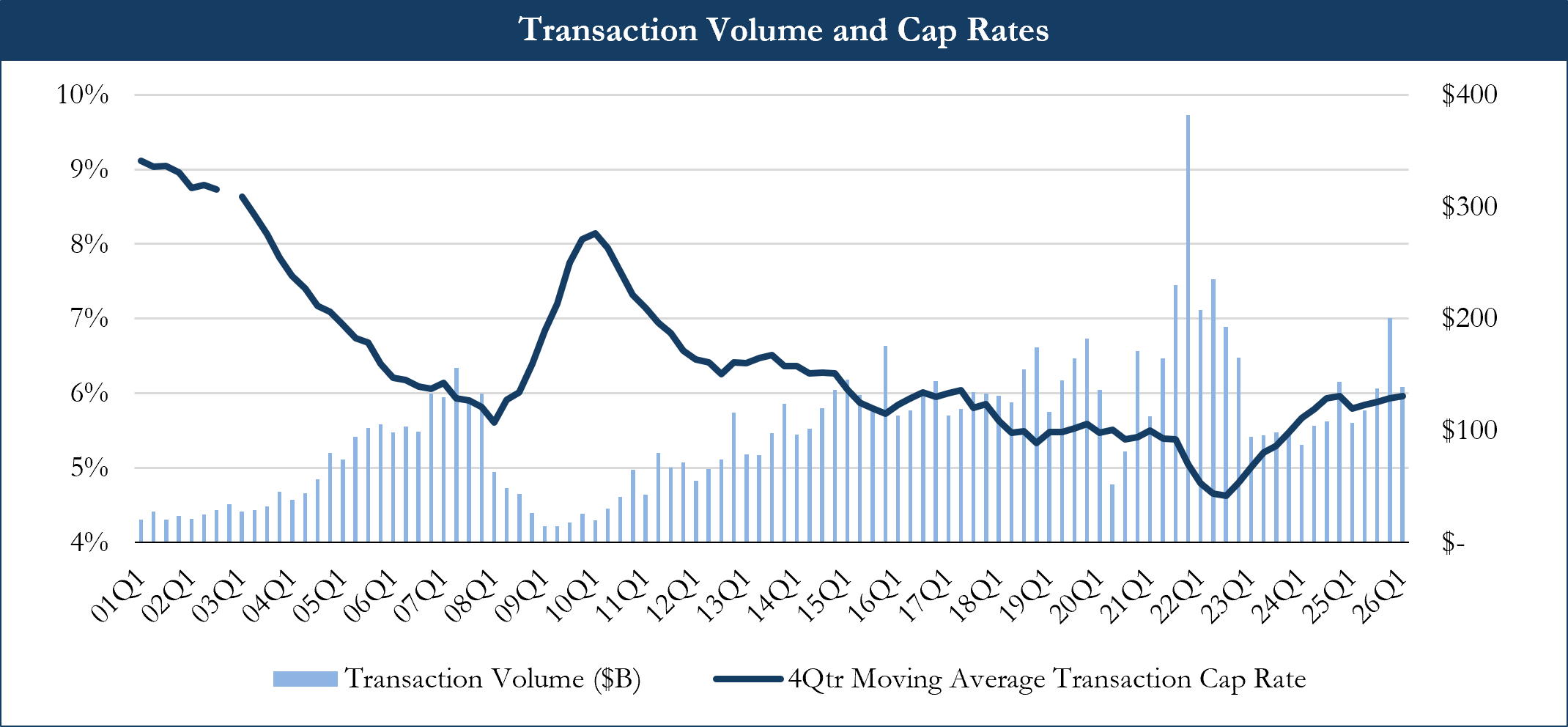
Source: Real Capital Analytics and NPI Trends Report as of March 31, 2026.
Today’s reality is that an investor is unlikely to succeed by relying on cap rate compression to achieve compelling returns as acquisition basis and NOI growth from operations are likely to continue to drive investment performance. Accordingly, ORG believes that basis must now stand on its own and be underwritten independently of any assumed improvement in market conditions. This begs the question of, “what is the right basis?”
Going In Yield on Cost
Going In Yield on Cost = (Year 1 Net Operating Income) / (Total Project Cost)
ORG considers the measure of appropriate basis to be going in yield on cost given that the total project costs must generate an unlevered yield that fully compensates for the asset’s specific risk profile before any leverage is applied. Going in yield on cost is calculated based upon net operating income (“NOI”) in the first twelve months of the hold period which removes often unrealistic rent growth projections layered into trended or stabilized yields and provides the most uncomplicated measurement of return. As is true with all input functions, other return metrics that rely on assumptions are only as strong or practical as the speculation involved in determining the inputs. Trended or stabilized yield on cost can be informative metrics with proper scrutiny of the underlying assumptions ensuring that they are not overly optimistic. Because of this, ORG prioritizes the evaluation of going in yields for all real estate acquisitions and believes that going in yield on cost should have a comfortable spread above interest rates.
Positive Leverage on Day One
With cap rates at compressed levels, ORG has observed capital allocators acquire real property at cap rates below the interest rate on the debt facility resulting in “negative leverage” as the cost of debt exceeds the property’s yield and is not accretive to returns. Negative leverage is generally discouraged but may be justified in business plans that are able to achieve strong rent growth, expense reductions, refinancing at lower rates or cap rate compression. Conversely, positive leverage day one is a result of the healthy application of debt where the cap rate well exceeds the annual interest rate representing accretive financing. While ORG has seen improvements towards a greater concentration of opportunities with positive leverage, the impact of leverage on property-level returns remains a priority in underwriting.
Debt Service Coverage Ratio
Debt Service Coverage Ratio = ( Net Operating Income) / (Annual Debt Service)
While basis is typically evaluated prior to the application of leverage, it is intrinsically tied to the viability of an asset’s capital structure. In order for a property to sustainably service its debt, in-place NOI should yield a substantial cash flow cushion that allows a property to absorb market volatility without requiring capital injections. It is standard for lenders to outline a minimum debt service coverage ratio (“DSCR”) in loan covenants, but a prudent investor should mandate actual DSCR is well above this floor to avoid default during periods of distress.
The Cost of Cap Rate Expansion
Financial models for real estate investment opportunities are based upon a set of assumptions intended to reflect the most likely base case outcome, however, exit metrics will inevitably fluctuate due to changes in market dynamics and business plan throughout the hold period. In a rich valuation environment, real estate investments can require substantially higher NOI growth in order to prevent capital loss during periods of cap rate expansion. To put this into perspective, transaction cap rates have widened from 4.7% in 2022 to 5.8% today[3] which would necessitate 23.4% in NOI growth to preserve asset value.
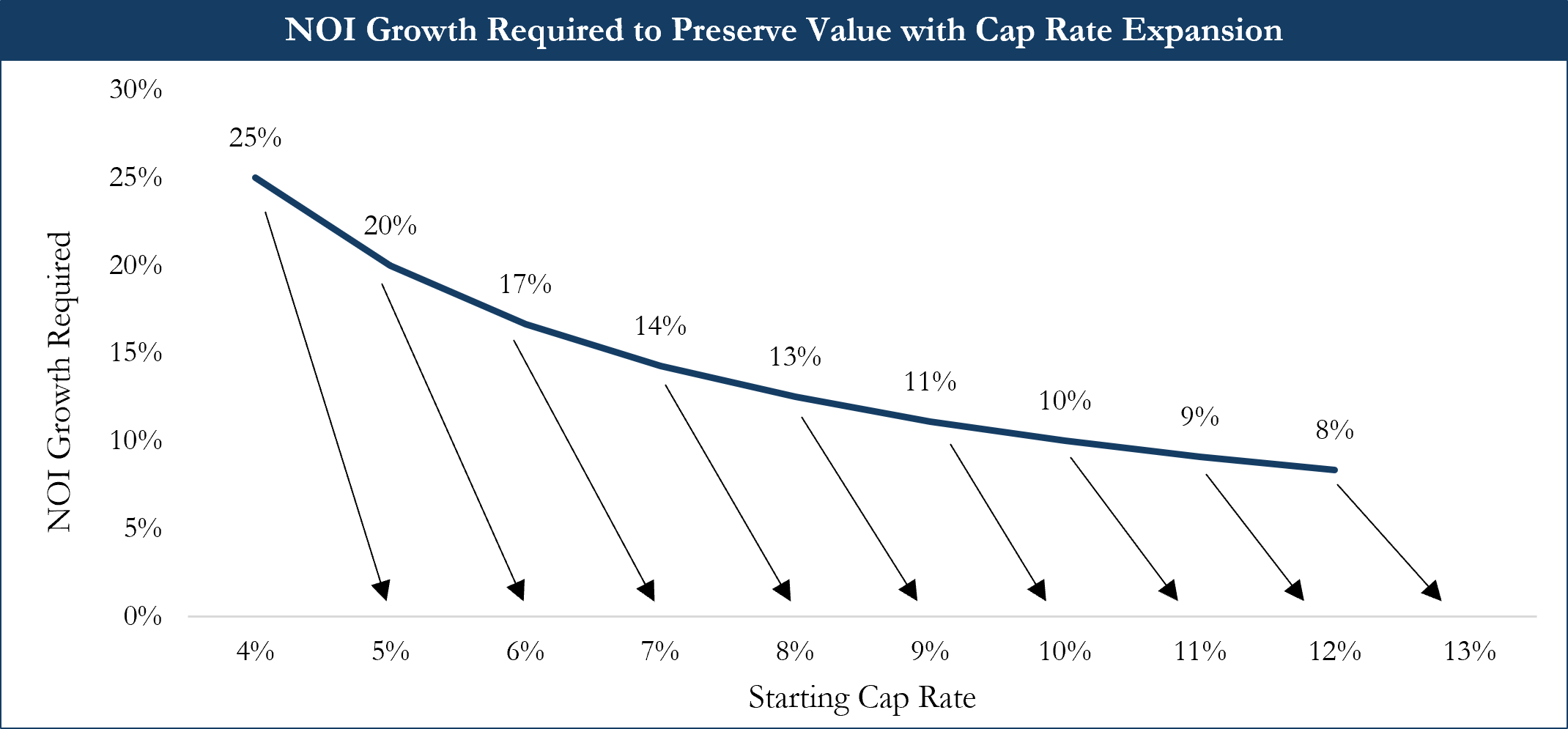
Source: ORG Research
Given that investors can rarely rely upon cap rate compression today, NOI growth is central to generating profits for the investor.
Sources of Return: Income versus Appreciation
In a post-thematic market, real estate investors should draw a distinction between returns generated by durable cash flow and those reliant on speculative appreciation. As a result of the previous cycle’s bond market, exit cap rates consistently compressed over hold periods despite the anticipated value reduction expected from the normal aging and deterioration of property conditions over time. Today, returns that rely on appreciation are effectively a wager on a less accommodating exit environment while returns generated by durable cash flow accrue to the investor throughout the hold period regardless of where valuations ultimately settle.
To insulate real estate portfolios against valuation volatility, ORG emphasizes that a minimum of 50% of returns should be derived from income generation versus asset appreciation as the latter is highly cyclical. Since the inception of the NCREIF-ODCE in 1978, cumulative income has generated a 6.4% annualized return compared to only 1.2% annualized return derived from cumulative appreciation[4]. With income contributing more than five times the annualized return of appreciation over nearly five decades, this disparity emphasizes that appreciation has been neither a consistent nor a primary driver of long-term performance in core portfolios. By establishing a floor on the income share of total return, portfolio performance can rely on the more predictable and continuously realized component of return rather than on gains that are only crystallized at sale and can reverse sharply during a market downturn.
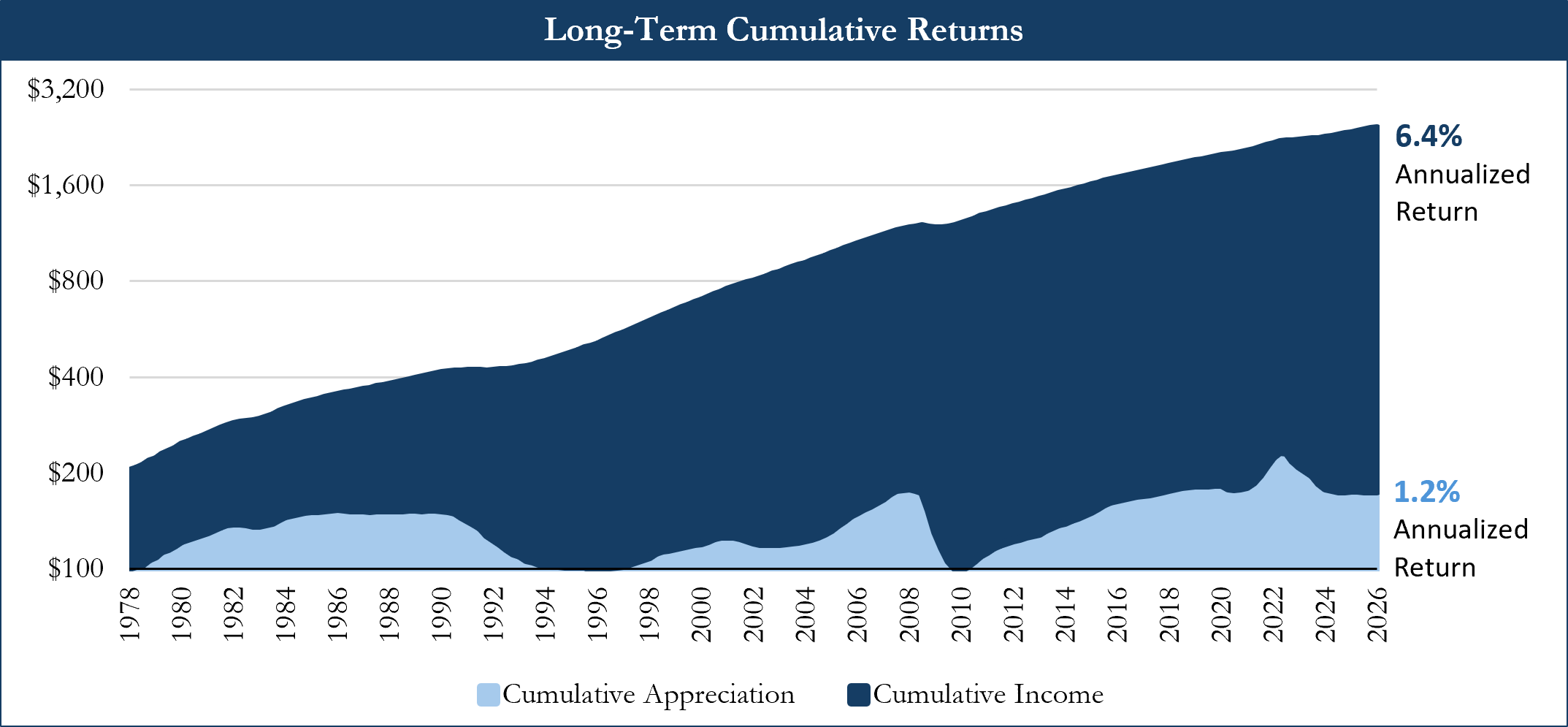
Source: NCREIF as of June 30, 2026.
The importance of income generation in real estate investing is further emphasized as appreciation has historically been derived from applying a cap rate to higher income levels at the time of sale. If a real estate investment is absent durable cash flow, achieving target returns in an environment with cap rate expansion becomes incredibly more complex. Therefore, underwriting should focus on the true durability of property cash flows by scrutinizing tenant credit, lease term obligations and localized economic drivers to ensure cash flows remain resilient through broader economic contractions. Prioritizing durability allows income to serve as the foundation of a portfolio since cash flows underpinned by creditworthy tenants and contractual lease obligations are less susceptible to the repricing that erodes appreciation-driven returns. By anchoring underwriting to income that can be sustained through a full market cycle, investors preserve the ability to compound returns steadily and avoid dependence on a favorable exit environment that may not materialize.
While traditional NCREIF-ODCE evergreen core funds have frequently been the vehicle in which investors gain income generating core exposure, these core funds have created challenges for real estate portfolios in recent years as they have historically struggled to fulfill redemption requests during periods of market decline rendering the marketed quarterly liquidity inaccessible to investors. Furthermore, ORG believes that the net asset value of many core funds is not yet reflective of current market pricing despite a stabilization in cap rates. Finally, NCREIF-ODCE funds must adhere to strict guidelines that can arbitrarily limit exposure to compelling opportunities such as no more than 25% of aggregate market value can be invested in niche property types like data centers, student housing and self-storage or no more than 60% of gross market value can be concentrated in a single property type. As a result, ORG has evaluated more creative opportunities to allocate capital to core level risk while maintaining consistent income generation such as real estate debt funds without margin call liabilities, closed-end funds investing in stabilized and light value-add assets, and non-NCREIF-ODCE open-end core funds.
Accurately Addressing and Quantifying Risk
One of the greatest weaknesses of the previous cycle has been the mispricing of risk with particular emphasis on the last five years where institutional investors have frequently accepted core type returns for value-add or even opportunistic risk profiles. During a period of abundant liquidity and steadily compressing cap rates, rising valuations masked the true risk embedded in many business plans and rewarded capital for taking on leasing, execution and development risk that was not adequately quantified. As competition for assets intensified, the return premiums that should have accompanied incremental risk were routinely compressed and the discipline of characterizing risk as compensated or uncompensated often weakened across the industry. Without the tailwinds of the previous cycle, that mispricing has now been exposed and investors can no longer count on a rising tide to rescue positions that were underwritten to inadequate risk-adjusted returns. Accurately quantifying and pricing risk has returned as a critical driver for preserving and compounding capital in the current environment.
Before risk can be priced, it must first be identified and the risks embedded in a real estate investment today are more varied and idiosyncratic than a single return target can capture. Leasing and vacancy risk reflects the possibility that space does not lease on the projected timeline or at the rent underwritten while execution and development risk captures the potential for cost overruns, construction delays and business plans that prove more difficult to implement. Tenant credit risk represents the durability of the income stream as a rent roll is only as reliable as the tenants obligated to pay it. Interest rate and refinancing risk have moved to the forefront given elevated borrowing costs and the volume of loans approaching maturity in a less favorable debt market. Liquidity risk was prevalent as transaction volumes thinned and redemption queues lengthened from 2023 to 2025, constraining an investor's ability to exit within the desired timeline. Finally, legislative and regulatory risk can suppress NOI growth and alter the return profile of an asset well after it has been acquired. A disciplined underwriting process should identify each of these risks explicitly rather than collapsing them into a single expected return.
While risks may be identified, a prudent investor recognizes that not every risk carries a reward. A compensated risk is one the market pays for through an adequate premium above the risk-free rate such as the illiquidity premium earned for accepting a multi-year hold period or the complexity premium available to investors willing to underwrite operationally intensive assets that others avoid. By contrast, an uncompensated risk is one taken on without a commensurate increase in expected return such as single tenant or single industry concentration risk, unanticipated deferred maintenance or capital improvements and applying excessive or poorly structured leverage. Any risk that can be reduced or eliminated through proper diligence, negotiation or transaction structuring without giving up return is inherently uncompensated.
Finally, quantifying risk requires a translation of qualitative judgments into explicit return thresholds by establishing a required risk premium for each strategy, measured as a spread over the risk-free rate and scaled to the severity of the risks that the business plan entails. The practice of quantifying risk also means underwriting the downside directly through scenario and stress testing, subjecting each investment to shocks in order to understand how much adversity the asset can absorb before capital is impaired. An opportunity that clears its return hurdle only under a favorable base case, yet fails under a reasonable downside, is one whose risk has not been adequately priced.
Conclusion
The transition away from an accommodative debt market reflects an enduring realignment in how real estate returns are generated. For much of the prior cycle, leverage and cap rate compression allowed capital to succeed despite elevated entry pricing and less disciplined underwriting but those tailwinds have receded and are unlikely to return at the scale that once defined the asset class. In the absence of these drivers, performance will be determined by the fundamentals discussed in this ORG Thought Piece. An asset should be acquired at a defensible basis that is underwritten independently of any assumed improvement in market conditions and portfolios should be anchored to durable income that accrues throughout the hold period rather than to speculative appreciation. Equally important, investors must demand payment for every risk assumed, restoring the distinction between compensated and uncompensated risk that eroded over the last decade. None of these disciplines is new or innovative but their reassertion will bifurcate uncompromising performance from returns that were a function of favorable markets. ORG believes that a rigorous, asset-level underwriting approach grounded in current cash flow and the accurate quantification of risk offers the most reliable opportunity to protect and grow capital in an environment where financial engineering no longer can.
[1] S&P 500 Index total return from October 22, 2022 to September 1, 2026 annualized.
[2] ORG Analysis of CoStar Group data of August 25, 2026. Analysis included transactions greater than $5 million over the last five years across Office, Retail, Multifamily and Industrial assets in the United States.
[3] Transaction Cap Rates NCREIF Trends Report as of June 30, 2026.
[4] NCREIF as of June 30, 2026.